
Steel and Glass Stair – Sicily

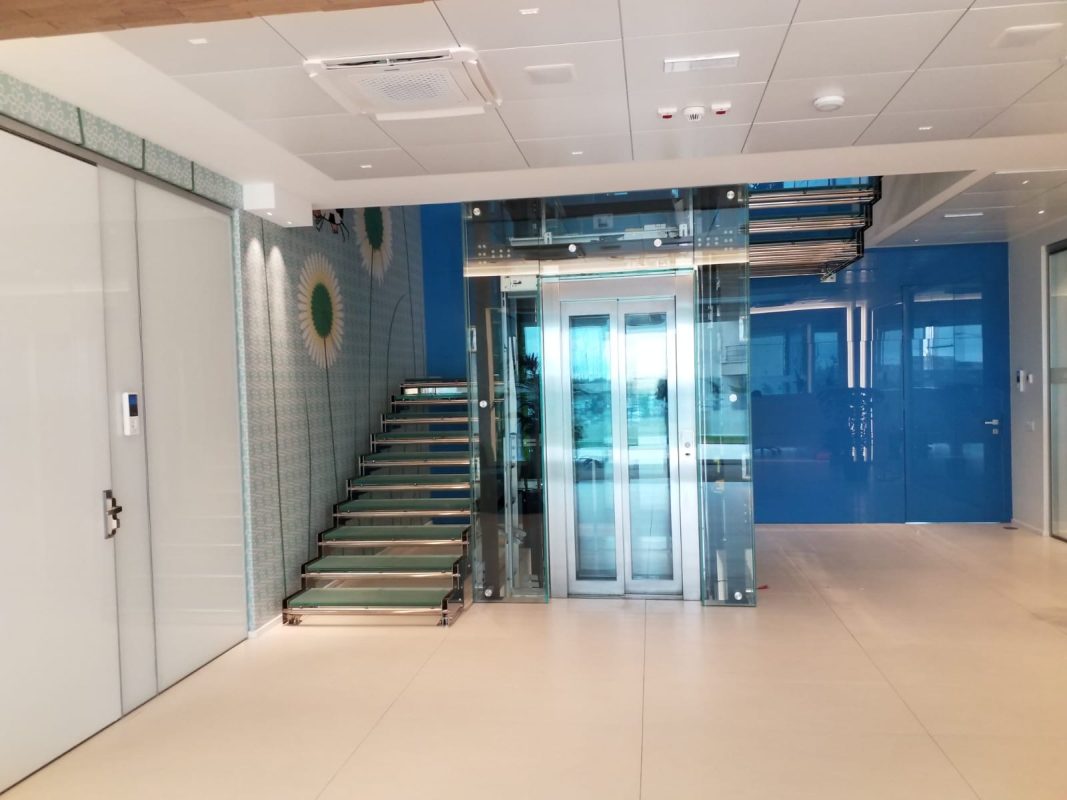
Metal stair from the E-TR line, entirely crafted in polished AISI 304 stainless steel, with glass treads and railing.
A metal stair from our E-TR line, entirely constructed in AISI 304 stainless steel, was selected by a leading company to connect the ground-floor offices with the executive offices above.
This stair is the result of an efficient collaboration between our team and the lead designer, combining the architect’s aesthetic choices with our technical expertise.
The client’s requirement was a stair that would seamlessly integrate with the environment, particularly with the panoramic elevator and the decorative glass panels covering the perimeter walls.
Since the space is open to the public and required accessibility solutions, an elevator was incorporated into the design. This choice, while functional, was also made for aesthetic reasons. In many cases, both the elevator and the staircase must serve practical functions, but their representational role and harmony with the architectural context are equally important.
The use of polished AISI 304 stainless steel gives the staircase the appearance of a chrome stair, while offering superior durability and material quality for a long-lasting result.
- LOCATION: Agrigento
- YEAR: 2019
- STATUS: Completed
- HEIGHT: 400 cm
- NUMBER OF STEPS: 25
- TREAD DEPTH: 120 cm
Enhancing and illuminating this structure are satin-finished, triple-layer glass treads, fully compliant with current regulations, and the glass railing. The latter was fabricated using an innovative technique that allows glass and metal—two entirely different materials—to be welded together. The handrail is therefore not simply attached to the glass railing with bolts or adhesives, but fully welded.
The stair, with a straight layout, consists of three flights interrupted by two landings, supported by a double stringer that eliminates the need for attachment to the perimeter walls, making it self-supporting. This design represents the cutting edge of both engineering and aesthetics, meeting any lifting requirements in civil and industrial applications.
This stair is a clear example of how a staircase, beyond connecting spaces, can enhance and enrich them.